By David Horst sandhill7@gmail.com
In 2006, I wrote an unabashed endorsement of Richard Louv’s “The Last Child in the Woods,” an enthusiastic but reasoned look at the healing power of nature and the ills of what he called Nature-Deficit Disorder.
Louv
will be here in the Fox Valley April 22-24, speaking six times in
multiple locations as a featured author for this year’s Fox Cities Reads
and the Fox Cities Book Festival.
So I’m calling the virtual Richard Louv Book Club into session right
now. (Full disclosure: A grant program I work with in my day job at the
Community Foundation for the Fox Valley Region is one of the funders of
Louv’s appearance.)Your
first assignment is to go to www.uponthesandhill.blogspot.com to read
my 2006 column and to read “Last Child in the Woods” — in that order.Next, we begin our critique and discussion of Louv’s followup book, “The
Nature Principle: Reconnecting with Life in a Virtual Age.” In it, he
applies to adults the lessons he uncovered in “Last Child.” He proposes
there can exist the hybrid mind, enhanced by electronics like iPhones
and video games, but calmed and focused by nature.

Monday, April 15, 2013


Saturday, April 13, 2013
Cure offered for nature-deficit disorder
This is a repost of a 2006 column on Richard Louv's "Last Child in the Woods." He has been named the featured author for the 2013 Fox Cities Reads and will make multiple appearances for the Fox Cities Book Festival.
By David Horst sandhill7@gmail.com
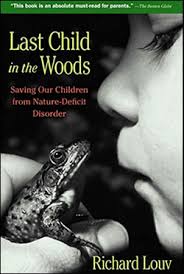
A book that finds hope for Earth’s future in treehouses and walks in the woods has been sweeping the nation, or at least the part of it populated by environmental educators and advocates.
As with most things, I caught the back of the wave. Richard Louv’s “Last Child in the Woods: Saving Our Children from Nature-Deficit Disorder” (Algonquin, 2006) was already out in paperback by the time I picked it up.
Louv had me in the introduction. In recounting his childhood, he described mine. Knowing every bend in the creek. Wandering the woods on well-worn paths. Building forts. Catching crayfish with bits of liver tied to string.
My well-worn paths ran along Lincoln Creek (that’s pronounced “crick”) in Milwaukee. The crayfish came from the big lagoon at McGovern Park. The fort was in my friend Richard’s back yard, built with wood from my dad’s job site.
But that was then and now is a world of stranger danger paranoia, videogame hypnosis and league play for anything that would take a child outside.
By David Horst sandhill7@gmail.com
A book that finds hope for Earth’s future in treehouses and walks in the woods has been sweeping the nation, or at least the part of it populated by environmental educators and advocates.
As with most things, I caught the back of the wave. Richard Louv’s “Last Child in the Woods: Saving Our Children from Nature-Deficit Disorder” (Algonquin, 2006) was already out in paperback by the time I picked it up.
Louv had me in the introduction. In recounting his childhood, he described mine. Knowing every bend in the creek. Wandering the woods on well-worn paths. Building forts. Catching crayfish with bits of liver tied to string.
My well-worn paths ran along Lincoln Creek (that’s pronounced “crick”) in Milwaukee. The crayfish came from the big lagoon at McGovern Park. The fort was in my friend Richard’s back yard, built with wood from my dad’s job site.
But that was then and now is a world of stranger danger paranoia, videogame hypnosis and league play for anything that would take a child outside.
Sunday, March 24, 2013
Snow banks soon will fill river banks
By David Horst sandhill7@gmail.com
As I drive between the darkening banks mounded along Highway 15, I’m not seeing snow. I’m seeing future river water.
The red-winged blackbirds are trilling. The sandhill cranes have returned to the sand hill we call home. Winter has held us in its grip long enough.
Already, the creviced ice is receding to narrow frozen ledges along the shore and diehards are sliding canoes and kayaks over them to get back to the water.
The small but interesting band of paddlers I keep company with spent the off-season planning year number four of the Fox-Wisconsin Heritage Paddle series.
These about monthly paddles started in 2010 with a journey down 190 miles of the upper and lower Fox River. Not all of it -- but enough to see the river’s varied faces and the many moments in time suspended along its banks.
A highlight was cruising amid the tall ships -- wooden replicas of historic sailing ships that visited Green Bay in 2010.
For Fox-Wisconsin Heritage Paddle 2013, the tall ships are back. But that’s in August and I’m getting ahead of myself.
As I drive between the darkening banks mounded along Highway 15, I’m not seeing snow. I’m seeing future river water.
 |
| 2010 Tall Ships paddle |
The red-winged blackbirds are trilling. The sandhill cranes have returned to the sand hill we call home. Winter has held us in its grip long enough.
Already, the creviced ice is receding to narrow frozen ledges along the shore and diehards are sliding canoes and kayaks over them to get back to the water.
The small but interesting band of paddlers I keep company with spent the off-season planning year number four of the Fox-Wisconsin Heritage Paddle series.
These about monthly paddles started in 2010 with a journey down 190 miles of the upper and lower Fox River. Not all of it -- but enough to see the river’s varied faces and the many moments in time suspended along its banks.
A highlight was cruising amid the tall ships -- wooden replicas of historic sailing ships that visited Green Bay in 2010.
For Fox-Wisconsin Heritage Paddle 2013, the tall ships are back. But that’s in August and I’m getting ahead of myself.
Sunday, February 24, 2013
Climate affects small bale economics
By David Horst sandhill7@gmail.com
Paul Robbins has an environmental institute at his disposal, with many ways to measure the impact of the Midwest drought on the economy.
I have only one.
I heard Robbins, executive director of the University of Wisconsin Nelson Institute for Environmental Science, speak eloquently and convincingly to the Appleton Noon Rotary about the need to determine and communicate the impact of climate change specific to Wisconsin's businesses, farms and people.
Afterwards, I offered him my measure -- the price of hay.
Due to another poor growing season, square bales of hay that hobby farmers like me were buying for $2.50 to $3 each for years, this fall were going for $6 or $7 per bale, if you could find any.
Here’s my analysis of small bale economics.
 |
| Paul Robbins |
I have only one.
I heard Robbins, executive director of the University of Wisconsin Nelson Institute for Environmental Science, speak eloquently and convincingly to the Appleton Noon Rotary about the need to determine and communicate the impact of climate change specific to Wisconsin's businesses, farms and people.
Afterwards, I offered him my measure -- the price of hay.
Due to another poor growing season, square bales of hay that hobby farmers like me were buying for $2.50 to $3 each for years, this fall were going for $6 or $7 per bale, if you could find any.
Here’s my analysis of small bale economics.
Subscribe to:
Posts (Atom)