Saturday, October 28, 2023

Trekking into Retirement: Door County

David Horst, 10.28.2023

TREKKING INTO RETIREMENT: Door County

When my wife, Jean, and I retired in 2023, we vowed we would remain active outdoors. We promised to go on "mini adventures" on nearly a weekly basis. I will report on some of these in a series we’re calling “Trekking into Retirement.” Feel free to reprint or otherwise distribute these essays to others.

Never in my 65-plus years have I hit peak color on a leaf-peeping trip. That string ended Oct. 20 during a long weekend in Door County.
The drive up through Brown County hinted at what we would see. Hillsides beyond the farm fields were painted bright yellow, orange and crimson. Jean and I were on our way to our first post-retirement overnight getaway and the first one we've had in a long. long time. 

Another vehicle contained my wife's mother, brother and sister-in-law. Animals had always prevented such a vacation. A neighbor was taking care of the animals, except for the two dogs. Them we had on board.


They were in dog crates, preventing the inevitable accident should the 9-month-old unknown mixed breed named Elsie been free to climb into the driver's face. Ten-year-old Rosie, a yellow Lab, would have been fine. I have to admit we never completed the series of ever-longer trial car rides we had planned, but their car manners were perfect. 

The "Trekking Into Retirement" portion of this trip took place at the Mink River Estuary Trail, owned by the Nature Conservancy. TNC is a wonderful group. They exist to preserve special natural areas through landowner donations, grants and tax deductions. The public owes a debt of gratitude to TNC chapters for forestalling development of areas that are the legacy all of us should be able to see. 

With a trailhead located south of Ellison Bay on Mid River Road, the Mink River trail is 1.3 miles out and 1.3 miles back, with a side trail that adds about half a mile out and back. It is an old-fashioned hiking trail, not a 12-foot-wide strip of asphalt built for
bicyclists, though three off-roaders were among the few people we saw. A path the width of two human feet leads you through patches of pines, cedars or mixed hardwoods. Whether you are a fan or oaks, maples, birch or ironwood, you will find trees for you. The lingering, dry summer not only helped the color show, it sustained the ticks. Rosie has a Lab's nose and she frequently stuck it into clumps of brush. At one point, Jean removed 13 tiny ticks from Rosie's face, a reminder to tuck your pants legs into your socks and do tick checks afterwards.

No one said Trekking into Retirement was going to be without challenges. 

By the time our short getaway had endedded, wind and rain were ripping the colorful leaves from the tops of the trees. Beauty is a fleeting commodity, but we had experienced the peak. That'something that stays with you.

++ Photos show the morning sun casting color on the shoreline and dogs Elsie and Rosie.

Sunday, January 15, 2023

With Russell’s passing, we’re missing the best kind of boring

The first thing you need to know about our dog Russell was that his previous family brought him back because he was "too boring."

Boring is a trait I’ve always wanted in a dog, so we signed the papers at the Waupaca Humane Association shelter and made Russell’s next home ours.

It’s true, he had no use for balls or stuffed toys that look like cats or dinosaurs. Fetch was a game for dogs who needed affirmation. Russell was secure with his own value. Though he was OK with visitors going on about how handsome he was. And they invariably did.

We had 10 years with this gentle, handsome, ok, boring dog. Our time together ended Jan. 11 on a day and time we chose. That is to say we called our vet and made the hardest decision a pet owner ever faces – euthanasia.

Being able to decide when to end a creature’s life makes it clear society views our pets as property. It is in truth a huge responsibility. It may seem more logical, more humane than not doing it, but it never feels like the unquestionably correct decision. Just like every other time we had to make this choice, I had to suppress an overwhelming urge to yell, “No, stop!”

Russell, a 14-year-old Lab-terrier mix, had nasal cancer. He was the second of our dogs to develop the disease that vets tell us is extremely rare. Our first clue was droplets of blood falling from his nose and huge sneezes that sometimes slammed his sweet face on the ground.

When he was diagnosed in September, we were told to expect he would have maybe four to six weeks. Without any chemo treatments, he made it past Halloween, then Thanksgiving, then Christmas, then New Year’s.

Russell’s sense of self-confidence meant he was never in a hurry to walk anywhere. We called it Russell speed. Yell until your face turned blue or hold out any manner of treat and it didn’t speed up Russell speed.

He was not in the least food-motivated. He did enjoy a good drink of water, but not the stuff from the tap. Something sweltering in a bird bath or an uncovered bucket was more to his liking. Better yet if muddy and stuffed with leaves.

The combination of his gentle presence and his handsome face made it impossible to stay angry with him.

In recent years, we have taken “pasture walks” with the Russell and our 8-year-old Lab, Rosie. This was a loop around the outside perimeter of the llama pasture that took about 15 minutes, depending on how many new smells we found. One afternoon, we looked and called and called and looked and couldn’t find the dogs. Finally, we spotted them at the top of the pasture. When we were too busy to go for a pasture walk, they decided to take each other.

Russell’s decline was marked by more bleeding, weakened rear legs and general confusion. He had four seizures, shaking violently for several minutes. The fear was obvious on his face – and ours. His awareness seemed to improve after the seizures. He walked with more purpose, rather than turning left again and again.

He stopped eating. We offered him chicken and rice, baby food, even Braunschweiger, but he refused them all. He grew thinner and weaker. His quality of life had diminished greatly and there was no chance it would ever return.

Finally, we agreed it was time.

Our vet, Jim Ziegler, takes in all manner handicapped dogs and sticks with them until life is no longer a favor. He is kindness embodied. He agreed it was time.

He came to our house to administer the injections. Russell was on his favorite bed in front of the fireplace. When it was over, he appeared to be sleeping where we had seen him 1,000 times. But the reality was that he is gone from our lives.

His ashes will join those of our other past pets. The memories of this delightfully boring dog will live on in mental images of him circling the pasture, watching for us from the sidelights of the front door or lying in his guard dog spot on a grassy hill. We will encourage those images by retracing his steps – at Russell speed.

Thursday, June 25, 2020

This time, crane hunt may be serious


By David Horst

Wisconsin’s Natural Resources Board clearly has a taste for sandhill crane.

They discussed the possibility of a crane hunt at their June 24 virtual meeting. Three times in the past seven years, Wisconsin’s Conservation Congress voted for a sandhill crane hunt. Nothing came of it. Nothing comes of a lot of Conservation Congress votes. The hearings, held all around the state, always have a noisy “shoot it if it moves” minority.

But this is not a bunch of aging hunters down at the town hall telling how they’d like things to be. This is a state board with actual oversight powers over the Department of Natural Resources. The Board heard a report on the status of Wisconsin’s sandhill crane population, called for by member William Bruins, a dairy farmer from Waupun. 

The facts were laid out by Taylor Finger, DNR migratory game bird specialist. He showed a graph of the sandhill population growth that started with next to zero 30 years ago and has grown to 90,000 birds in the fall count. The growth has been dramatic in recent years.

That led Bruins to ask Finger if it wasn’t obvious that a hunt was needed. Board Chair Frederick Prehn, a dentist, cranberry grower and gun store owner from Wausau, took Finger off the hook, saying he appeared with the understanding he would only present facts and not draw any conclusions about whether a hunt was or was not justified.

Finger’s response brought in another point of view. He said there is also a “social consideration.” Sandhill cranes are big, charismatic birds, he said, that 30 years ago weren’t seen in Wisconsin. His hand tipped the other way when he took away one of the arguments always presented by hunt opponents. Asked if endangered whooping cranes mixed in with the sandhill flock might be killed by mistake, he said hunts of our eastern sandhill flock already allowed in Kentucky. Tennessee and, most recently, Alabama have produced no reports of whoopers mistakenly shot.

There actually are already two types of crane hunts in Wisconsin. Farmers, after trying other required techniques for mitigating crop loss, can be given permits to shoot cranes. But they aren’t allowed to eat what they shoot. Native tribes can shoot up to 50 cranes a year. Finger said they’ve never come close to taking half that number.

My interest in cranes is not how they taste, but the flavor they bring to my life. We get regular visits from sandhills. They are grace in motion. We watch them stretch and preen. As I write this, a pair stands at the edge of our backyard calling out what I can only interpret as, “Give ’em hell.”

I take part in the annual Midwest Crane Count and my numbers have been stable. I am seeing cranes more places.

The arguments will be the same as before. Stories of cranes walking down a row of corn seedlings and gobbling them all down. Descriptions of blast-happy hunters that don’t want the meat, they just want to kill.

I’ve never seen a crane devour a row of corn. I did see one snark up a mouse or a vole the other day. I get a big kick out of watching them land or take off or communicate with their dance of hopping and wing flapping. I have as much right to the joy they bring me as hunters have to the satisfaction of shooting them.

There were clearly a couple votes on the NRB opposed to the hunt. Given the number of hunters and farmers on the board, I think I know which way this is going to go. Watch the meeting video at this link and handicap it for yourself.

Chairman Prehn said he would talk with DNR Secretary Preston Cole over the summer to decide if the agency and the board will ask for a hunt together or the board will go it alone – if the board so decides.

No matter how that vote goes, an actual hunt would require action by the Wisconsin Legislature. We have indecision and partisanship working for us there. Jump on the issue with your legislators now if you feel strongly about a crane hunt.

Because of their beauty, size and graceful movement, cranes are considered sacred in many cultures. Here, we have to ask, is nothing sacred anymore. I think the answer is clear.

Thursday, November 7, 2019

Check out the winter edition of Wisconsin Natural Resources

The winter edition of Wisconsin Natural Resources magazine includes my feature on Pat Fisher, who runs The Feather bird rehabilitation center in New London. You will find it at https://dnr.wi.gov/wnrmag/

Here are links to my previous stories in Wisconsin Natural Resources and other stories I've done on Pat.

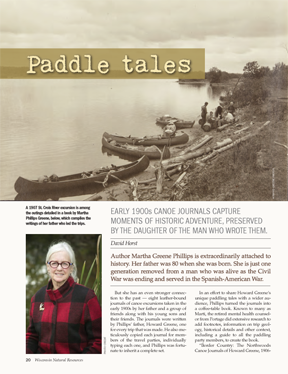
Paddle Tales (WNR)
Journals of canoe trips long ago


Natural Leader, Nature Champion (WNR)
Gordon Bubolz's other natural areas


Injured eagle lifted by helping hands


Sunday, May 26, 2019

Taking sides in survival of the fittest

By David Horst

You never know what you'll see out of our
window to wildlife
That whole food chain/survival of the fittest thing looks a lot better in theory than on the hoof.

We were looking out the window to wildlife in our living room one evening. About 10 deer and a pair of sandhill cranes were out there. I believed them to be the same cranes we had seen several days earlier.

On that evening, one crane landed and then the other. The first started running in a straight line with its wings stretched out. It looked pretty threatening, so I assumed it was territorial. This display went on for a bit until it became clear these were not two males drawing a line in the sand. They were a couple having a roll in the hay. The show might happen again, so we were keeping an eye out.

The deer were acting oddly. They looked around nervously and flashed their flags – the white underside of their tails – signaling danger. Then the deer were on the move. They closed ranks and took off east. Shot from the brush came a low, brown, speeding figure. It was a coyote and it was gaining. It also was getting near to the cranes, 4-foot-tall birds that need some time and space to get airborne.

The coyote was just performing its role at the top of the food chain. Actually, they call it a food web now. It’s more complicated than just a straight chain. But seeing the coyote claim the rights that go with being at the top of the web was not going to be pretty.

As it turned out, the cranes took their cue from the deer and had made short work of getting up higher than a coyote’s leap. The deer bolted into the woods. The coyote made an about-face and raced back to the west.

The evening light was dimming, but the deer all appeared to have escaped, as had the cranes.

I’m perfectly aware that an individual one way or the other won’t make a bit of difference in the deer population. Coyotes gotta eat, too. But I was cheering for the deer.

Everybody still holds their positions on the food web, so the scene is likely to be repeated, possibly with a different ending.

The cranes returned quickly after the coyote disappeared. They settled down into the hay field. One stretched out its neck and ran with its head down.

That’s another force in nature that continues the food web.

Sunday, April 14, 2019

Count on cranes to know weather

By David Horst

Sandhill crane mating behavior 
I took part in the annual Midwest Crane Count Saturday morning. That means being in place at your assigned counting area by 5:30 a.m. and staying there counting until 7:30 a.m.At 33 degrees with a stiff wind, the sandhill cranes had the good sense to stay in the woods until 6:38 a.m.

Snow from this year’s April storm still lined the rows between the corn stubble. It was better than last year’s April storm, which prevented me from getting to my site.

After an hour of seeing no cranes, the weeds and fence posts start to take on that role, until you fine tune the focus on the spotting scope.A good spotting scope is a big help on the crane count. The cranes aren’t really interested in being close to you. I could make out their figures in the morning light, but the scope allowed me to see what they were doing and get a more accurate count.
At 6:38 I finally saw two birds feeding in the field. By 6:50 there were four. At 6:58, six. At 7:10, 10 cranes. That would hold steady as my count, just as 33 held steady as the temperature.
The behavior I recorded for all 10 was “walking and feeding.” In warmer years, I sometimes saw mating behavior — cranes hopping up and down with their wings spread, or even tossing a small stick into the air repeatedly. Hey, who’s to judge what turns on another species.

This year I left all of the checkboxes for mating behavior blank. But I was still out in nature, watching the morning come. And I had the company of 10 very large, impressive birds.

Annual Midwest Crane Counts

  • 2019 (10 cranes)
  • 2018 missed due to weather
  • 2017 missed due to illness
  • 2016 (28 cranes)
  • 2015 (32 cranes)
  • 2014 (15 cranes)
  • 2012 (9 cranes)
  • 2010  (9 cranes, 1 county supervisor)
  • 2009 (15 cranes, 2 children, 0 whining)
  • 2008 (26 cranes)


Sunday, January 20, 2019

The science of noticing stuff

By David Horst

I really love the concept of phenology.

This woodcook didn't check a phenology calendar.
It came to our house with snow still on the ground.
The unscientific definition is you sit outdoors and notice stuff. You do this every year and record the day the first bluebird arrives or when the owls start their winter hooting. The possibilities are as endless as the list of plant and animal species.

Over the years, you build a calendar of when all of these “firsts” happen and check if the dates change.

Friends recently bought us a copy of the phenology calendar sold by the Aldo Leopold Foundation. The pioneer environmentalist was an avid recorder of events in nature. He even knew from using a light meter that it was at precisely at 0.50 foot-candles of light during sunset that the woodcocks on his central Wisconsin farm would start their mating behavior, which involves a male woodcock diving from high altitude and folding his wings just so to create an eerie whistling sound. You can read about that in the essay “Sky Dance” in Leopold’s literary treasure A Sand County Almanac.

Having the calendar adds to our daily breakfast table a recitation of the day’s nature events. The Leopold Foundation is near Baraboo, so the dates all reflect what’s happening in the Madison area. We are a few days behind that here in the Fox Valley.

Checking the recent entries on Sunday suggested the more modest among you should walk through the woods with your eyes covered in the coming week. Wednesday, Jan. 23, the red foxes begin mating. It’s hard enough to see foxes in the wild so an embarrassing encounter is unlikely.
Wolves get frisky on Jan. 24. This brings to mind the mating practices of Klingons on Star Trek.

Beavers will be at it Jan. 25 and lynx the next day. Gray and fox squirrels get to it Jan. 28, as if there aren’t enough of them already.

Other than Canada geese arriving Friday – and with the number of resident Canada geese we have, that’s no big deal -- the week in phenology is all about doing the nasty.

February will bring bluebirds, turkey vultures and skunk cabbage, at least in the Madison area. Before the last bite of toast is swallowed, we’ll know to look for them.

Monday, June 18, 2018

Upper Fox 2018

Northeast Wisconsin Padders (NEWP) organized a weekend paddle on the weekend of May 19-20.

Saturday, we launched at the White River Dam, near Princeton, and traveled the 13 miles to River Side Park in the City of Berlin, WI.  Due to heavy rain and snowmelt, the Fox River was very high. At the takeout, we cruised over submerged sidewalks and pulled up directly on the grass. 

Sunday, we launched where we had finished the day before and paddled another 13 miles to Omro, with a lunch stop at the Berlin Dam. For my money, this is the most beautiful stretch of the Fox.

Photos by Ron Starkey


Monday, May 21, 2018

Season's first paddle had some on, some in the Waupaca River

The Waupaca River delivers one more class 1 rapids at the end.

By David Horst
sandhill7@gmail.com 


It has to be said. We got some people wet.

The kickoff to the North East Wisconsin Paddlers 2018 Public Paddle series on May 5 was a little more challenging than our usual afternoon outings on a lazy river.

We opened the season with a segment of the Waupaca River from County Q to Brainard's Bridge Park, just upstream of the City of Waupaca. It includes a few sections classified as class 1 rapids, the lowest category in the whitewater rating scale.

Ken plays in the segment's final rapids
The pre-trip description on our website (www.wisconsinpaddlers.org) warned that this trip was not for novices. As a result, our count was held down to 23 participants -- both when we launched and when we took out. We encouraged people to leave the bent wood and Kevlar kayaks at home and dig up the old plastic beater instead. It was good advice.

My trusty old Perception Carolina took a hard smack from rocks on both sides. The acrylic-covered plastic that it's made of absorbed the punishment without damage. I also got hung up on a rock at one point and trapped by a downed tree at another. But I stayed dry.

Friday, May 18, 2018

Back to back


Coming soon: Another story in Wisconsin Natural Resources Magazine.
This one tells the story of Howard Greene's journals of canoe trips
taken in the early 1900s with "The Gang." 

Wednesday, April 11, 2018

Gordon featured in magazine story


My story on Gordon Bubolz, conservative businessman and conservationist, is in the current issue of Wisconsin Natural Resources Magazine. Check out the list of 10 NE Wisconsin natural areas that we have Gordon to thank for acquiring.


Monday, January 29, 2018

Father’s journals recall camping a century ago

By David Horst, sandhill7@gmail.com


DE PERE -- Author Martha Greene Phillips is extraordinarily attached to history.

Her father was 79 when she was born. She is just one generation removed from a man who was alive as the Civil War was ending and served in the Spanish-American War.
Martha Greene Phillips

There’s an even stronger connection -- eight leather-bound journals of canoe excursions her father took with a group of friends, his sons and his sons’ friends. She turned the journals into Border Country, the Northwoods Canoe Journals of Howard Greene, 1906-1916, University of Minnesota Press. The 408-page history includes 366 photos, plus maps and sketches, and fully reproduces six of Howard’s journals, with summaries of the other two.

She described the book and her father’s adventures in a presentation at the North East Wisconsin Paddlers annual meeting Saturday (Jan. 27) at Legends in De Pere. NEWP (www.wisconsinpaddlers.com) is a nonprofit dedicated to advancing paddle sport education and safety and the sponsor of kayaking instruction and an annual series of public paddles.

Howard Greene

Sunday, October 22, 2017

October paddle extends the season

By David Horst   sandhill7@gmail.com

A day in mid-October with a forecast of sun and temperatures in the low 70s. Not something you pass up. It needed to be a paddle weekend.

I emailed paddle buddy Jeff Mazanec and made plans for a short trip.
We settled on the Waupaca River from Weyauwega to Decker Park.

Coincidentally, this is one of our routes for the 2018 North East Wisconsin Paddlers public paddles. We needed a location, so why not pick one that we could scout for the group. Jeff, of Grand Chute, has an even stronger sense of responsibility (and so does the third main planner of this series, Tom Young of Fox Crossing) than I do, so he was fine with that.

The launch area is just below the dam that forms Lake Weyauwega. It’s on the north side of the river, at the foot of the grain tower that is painted with symbols of the area’s history.

A narrow path, maybe five yards long, leads down to a small pier about the right height for launching a canoe, but on the treacherous side for dropping down into a kayak. The flow is swift and the rocks slippery, but we managed to launch without contributing to the blooper reel.

Paddling the Waupaca
The route out of town takes you past the bread and butter of Weyauwega – Agropur cheese and Presto Products. Also Weyauwega-Fremont High School. Then on to rural beauty.

The first section of river has some ripples. They’d have to grow up quite a bit to be rapids, but they do signal underwater rocks best avoided. Other sections turn suddenly shallow with mucky sand slippery enough to glide through, until you push it too far and have to step out into the quicksand. We didn’t push it that far, but almost.

Jeff always takes sweep on our group paddles. He’s the last guy, making sure no one gets left behind and offering a tow to anyone who is struggling.

Today, he alternates between lead and sweep. There are only the two of us.
As fun as it is to fill a river with paddlers, sharing a river with just us is a refreshing change. We have time to talk – not just about who needs help or a paddler slipping off his PFD in violation of our rules. Today our conversation is about our families, our memories, our aspirations. 
 
I didn’t even bring a camera.

Jeff observes the river is wide enough that we aren’t likely to have downed trees block our way. The thought has hardly slipped off of his tongue when we swing around a bend to see tree trunk stretching across the channel.

Far river right there is a passage about twice the width of a kayak.

Time and time again we would encounter a tree and see the passage reveal itself.

Even with fall getting ready to entrench itself, signs of wildlife were everywhere. Pointy beaver sticks littered the shoreline. Patches of mud were scribed with a mosaic of footprints from beavers, muskrats and deer.

Great blue herons took the point for the first half our trip. I can confidently say herons, plural, but could not venture what part of the count should be credited to great blues who flew ahead and emerged again.

We never saw the bald eagle that usually graces our group trips. Instead, an osprey cruises the wind currents.

“An osprey is worth two eagles,” Jeff pronounces. Definitely in a bar fight, I was thinking. This osprey is pushing the migration window. Most would have headed toward Mexico and points further south by now, but a few linger through October.

We twist and turn through the final length of the Waupaca before it anonymously slips into the Wolf River.

The first inlet is populated with campers. Around a peninsula stands Gill’s Landing, a bar and restaurant. We land there. Many of the patrons have taken to the deck to soak in this extra summer day in October.

We join them to toast a day that cheated the end of paddle season.


x

Sunday, July 2, 2017

Water, water everywhere

By David Horst  sandhill7@gmail.com

We set out knowing we would be rained on.

One of the glories of kayaking is it doesn't matter if it rains. Your boat and your sprayskirt cover the bottom half of you and your raincoat and hat shelter the rest.

We were paddling the Caldron Falls pool of the Peshtigo Flowage -- one of eight days of paddling organized by North East Wisconsin Paddlers this season.

Camping at Gov. Thompson State Park, we are paddling an 8-mile out-and-back route Saturday and the High Falls pool on Sunday. Today's route is landing #13 to landing #12 and back.

The clouds were gathering and the forecast has made thunderstorms a certainty. But, remember, I no longer trust weather forecasters.

On the way back the rain started. It got harder. An

Wednesday, June 28, 2017

Consty's story ends

By David Horst  sandhill7@gmail.com 


An experience can be difficult, end badly and still be worth it. So it is with the last chapter of Consty’s story.

Constellatione has been with us for 17 years. Toward the end of last year, he started having difficulty walking. His feet would go every which way when he took a step. In early March, he went down and was unable to get himself back up.

After desperate day of him being outside in high winds, we were able to help him walk into the barn with the assistance of our vet and a young intern. 

At first, the diagnosis was that Consty had a parasite that attacks the spine. Later, it was determined that a cancerous tumor was pressing on his spine. Either way, he couldn’t stand.

Monday, May 22, 2017

Turning a cold shoulder to forecasters

By David Horst  sandhill7@gmail.com


We had a very nice paddle Sunday — a small, intimate group, strong flow in the river and the wind at our backs.

More on that, but first, I have to let loose of some rage.

Last Thursday — 48 hours before a weekend with two paddles scheduled on the Upper Fox River — the forecast for the Princeton area was unequivocal. From 9 a.m. to 6 p.m. Saturday, between 70% and 90% chance of thunderstorms. I’d never seen such a dramatically certain forecast telling padders to stay off of the water.

As organizers of the North East Wisconsin Paddlers public paddle series, our course was clear. We needed to call off Saturday’s trip for the safety of the participants and to give ample notice to people traveling from farther away. You don’t argue with 90% certainty of thunder and lightning. We posted the messages on web and Facebook and sent emails to everyone we expected to come.

I joked with fellow trip organizer Jeff Mazanec that by canceling the trip we probably guaranteed Princeton would see no thunderstorms Saturday.

My prediction turned out to be the only one that was correct.

Monday, May 15, 2017

Horicon Marsh holds bird life and history

Horicon Marsh is a huge pool among the nation’s fresh water marshes – the largest, in fact. But it also holds a tremendous volume of history.

See more photos.
Few are better equipped to recite that history than Bill Volkert, who retired after 27 years as a naturalist in the state portion of the marsh. Why there is state and federal sections is part of the difficult history of the place.

We retained Volkert to talk about Horicon’s twisted history and lead North East Wisconsin Paddlers’ first public paddle of the 2017 schedule on May 6. The trip drew 67 paddlers, many on their first NEWP paddle.

Volkert told of a visitor to the marsh who remarked on how wonderful it was that we – the royal WE – had preserved all of this wonderful wetland. That’s when Volkert recited the list of attempts by WE to make the marsh knuckle under.
Known now for its Canada goose population, Horicon of the early 1800s was prime duck territory. The first assault on the marsh was hunting clubs with shotguns of such a low gauge that a single shot could bring down as many as 50 birds. Understand, this was after centuries of Native American habitation.

Wednesday, April 19, 2017

2017 paddle season set


The 2017 Heritage Paddle schedule is now available. New paddles for the upcoming season include a naturalist-led tour of Horicon Marsh May 6 and two days on the Upper Fox River May 20-21 that we're calling -- to please the censors -- the Three Good Dams Paddle. It will take us from the Princeton Dam to the White River Dam one day, and White River to the Berlin Dam the next. Old favorites will be back -- including two days in the Peshtigo Flowage June 24-25, the 16th annual Park to Park Paddle July 22, a Moonlight Paddle from De Pere to Green Bay Aug. 4 and the Appleton Locks Paddle on Appleton's Octoberfest Saturday, Sept. 30.  See times and other details at www.wisconsinpaddlers.com.


Monday, March 27, 2017

Hope gives way to compassion

By David Horst   sandhill7@gmail.com

Hope gave way to compassion last Thursday.

We were barely into the barn when the vet pronounced hope was gone.

"We're in hospice mode now," she concluded.

Our 17-year-old llama, Constellatione, has not been able to stand on his own for several weeks now. In the world of a natural prey animal like a llama, that's a fatal flaw.

We've been holding out hope that lifting him daily with a cattle sling and an electric winch would get the strength back into his legs so we could see him grazing in the pasture once again.